 |
AKOS
v1.0.0
Documentation
|
|
AKOS
v1.0.0
Documentation
|
Kernel objects are the building blocks of an RTOS. In AKOS, they are the runtime structures the kernel manages on behalf of the application: threads, messages, timers, priorities, and the control state that keeps them moving together.
This chapter gives you a simple map of those objects before the later chapters go into each subsystem in detail.
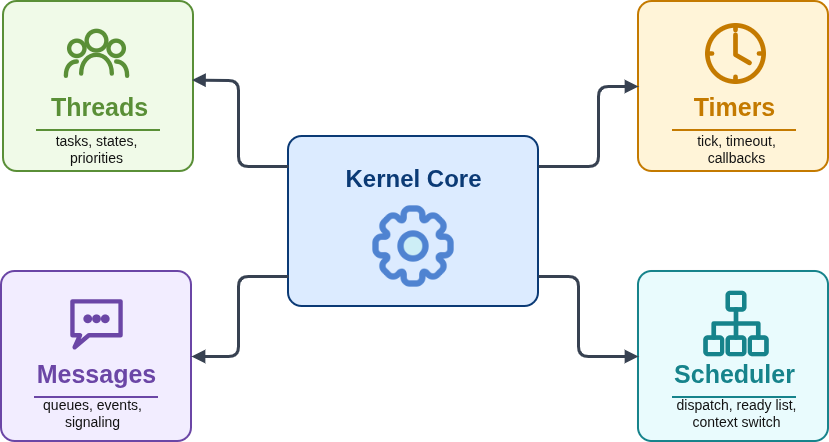
At a high level, AKOS organizes its kernel around a few core objects:
These objects are not isolated features. They are connected: threads wait for messages, timers wake threads up, and the scheduler decides which ready thread runs next.
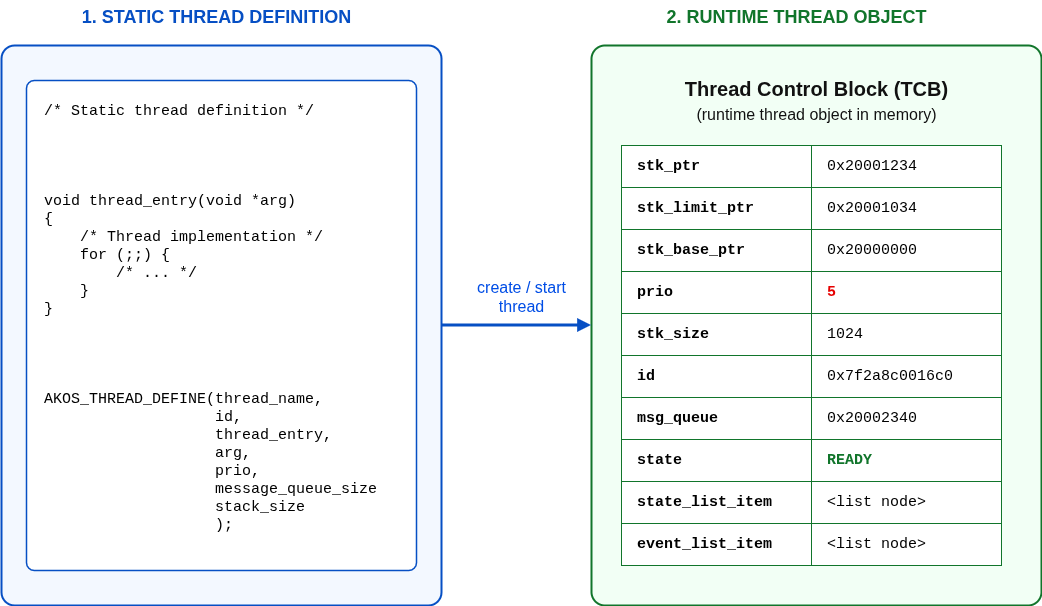
A thread is the basic unit of execution in AKOS. Each thread has:
AKOS_THREAD_DEFINE(...) is the static thread-definition API. It creates the compile-time thread definition that the kernel later turns into a runtime thread object during system startup.
The thread subsystem also keeps track of runtime thread state, such as whether a thread is running, ready, delayed, or waiting on a message.
Messages are the main communication object in AKOS. They let one thread wake another thread up with either:
The message subsystem uses:
This gives application code a clean way to pass events between threads without sharing state directly.
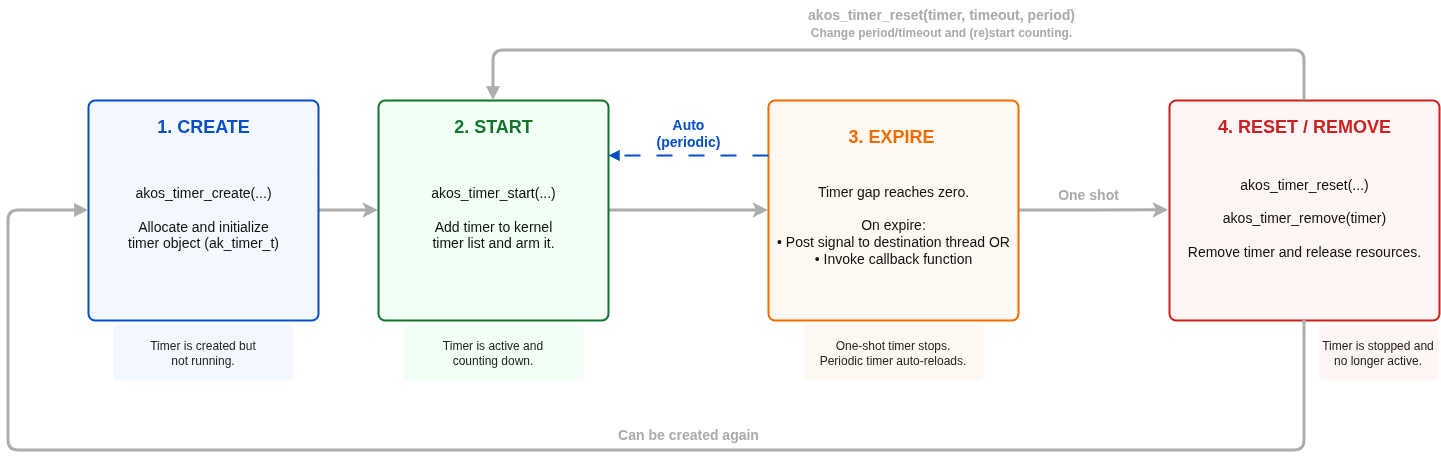
Timers are another kernel object that build on top of the message system. A timer can expire once or repeat periodically, and when it expires it can post a signal to a destination thread or invoke a callback.
The timer subsystem revolves around ak_timer_t and APIs such as:
Timers are especially useful when you want delayed work, periodic polling, small callback functions, or time-based events without blocking a thread.
Priority is what ties the kernel objects together. AKOS uses priority tracking to decide which ready thread should run next.
That means:
The scheduler is the control point that turns thread state into actual CPU execution.
AKOS also needs a small amount of kernel control logic around those objects. That is where core comes in.
The main control APIs are:
akos_core_init() prepares the kernel subsystems, while akos_core_run() hands control to the scheduler. The critical-section APIs protect shared kernel data structures so the object lists stay consistent across interrupts and thread context.
Interrupt service routines are not kernel objects in the same sense as threads or timers, but they matter because they can interact with the kernel at the boundaries.
In AKOS, interrupts typically feed events into the system, while the kernel keeps the runtime objects consistent and decides when a thread should wake up and run.
Once you understand the kernel objects, the rest of the documentation becomes much easier to read:
The short version is simple: AKOS is built from a handful of kernel objects, and the scheduler keeps them working together.
 1.14.0