 |
AKOS
v1.0.0
Documentation
|
|
AKOS
v1.0.0
Documentation
|
In RTOS systems, memory is usually limited. When an application uses malloc() and free(), it is usually working with a small SRAM pool. Those functions are part of the standard C library, so the application has less control over memory behavior, which can sometimes be dangerous. For that reason, RTOSes often implement their own memory-management module.
AKOS provides an alternative to malloc() and free() called akos_memory_malloc(size_t size) and akos_memory_free(void *p_addr). In the future, it may have additional schemes to support many application requirements. Let’s see how it works.
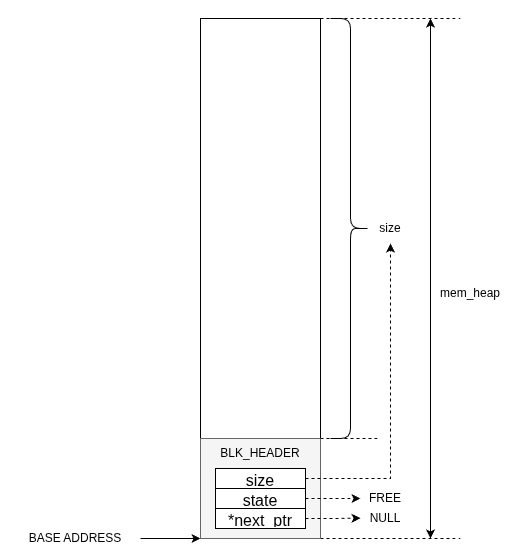
AKOS first obtains a memory block in SRAM with the size specified in config.h. In AKOS, this area is called mem_heap.
At initialization, mem_heap is one large block. Each time akos_memory_malloc(size) is called, if enough memory is available, mem_heap is split from one big block into smaller blocks. Keep in mind that every memory block has one BLK_HEADER.
To keep track of memory blocks, the BASE ADDRESS of mem_heap always has a BLK_HEADER.
Then, consider akos_memory_malloc(1024) being called. mem_heap becomes like this:
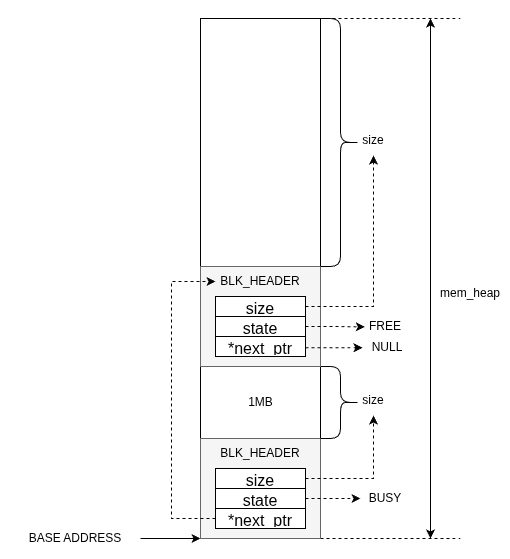
Lastly, when akos_memory_free is called with the address returned by akos_memory_malloc(1024), mem_heap goes back to its initial state.
 1.14.0