 |
AKOS
v1.0.0
Documentation
|
|
AKOS
v1.0.0
Documentation
|
AKOS is a small embedded real-time operating system built for microcontrollers. It is organized around a priority-based scheduler and an event-driven programming model, so application code can react to signals, timers, and state changes instead of relying on one large super-loop.
Many small embedded systems start with a foreground/background design, also called a super-loop. In that model, the application spends most of its time in one endless main loop and does work by polling flags, checking inputs, and calling small handlers in sequence.
Interrupt service routines still matter in that model. They usually do the time-critical work, then hand off the rest to the main loop by setting flags or updating shared state.
That approach is easy to understand and works well for very small problems. But as soon as the application grows, the limits start to show:
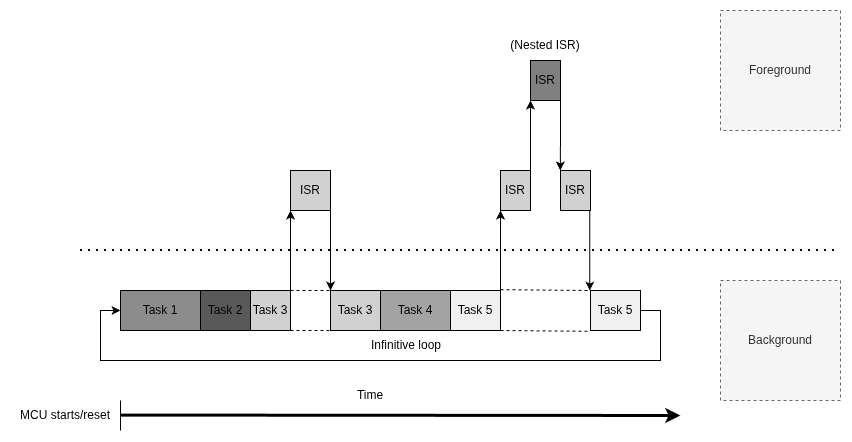
An RTOS exists to solve that next step. Instead of one loop doing everything, the kernel breaks the system into threads, schedules them by priority, and lets timers and messages drive work in a more structured way. AKOS is the RTOS used in this documentation, and it follows that model.
The RTOS System provides kernel. It is just additional software run before tasks or threads, responsible to manage the time and resources of MCU.
The application by kernel is split into small pieces of tasks, then decides what runs and when based on priorities and time slice. On a single CPU, only one task executes at any given time. A task is also typically implemented as an infinite loop and it thinks that it has the CPU completely to itself.
These parts work together to keep the system responsive and predictable. The kernel does not replace the application; it organizes it so each piece can do its job without one long loop holding everything together.
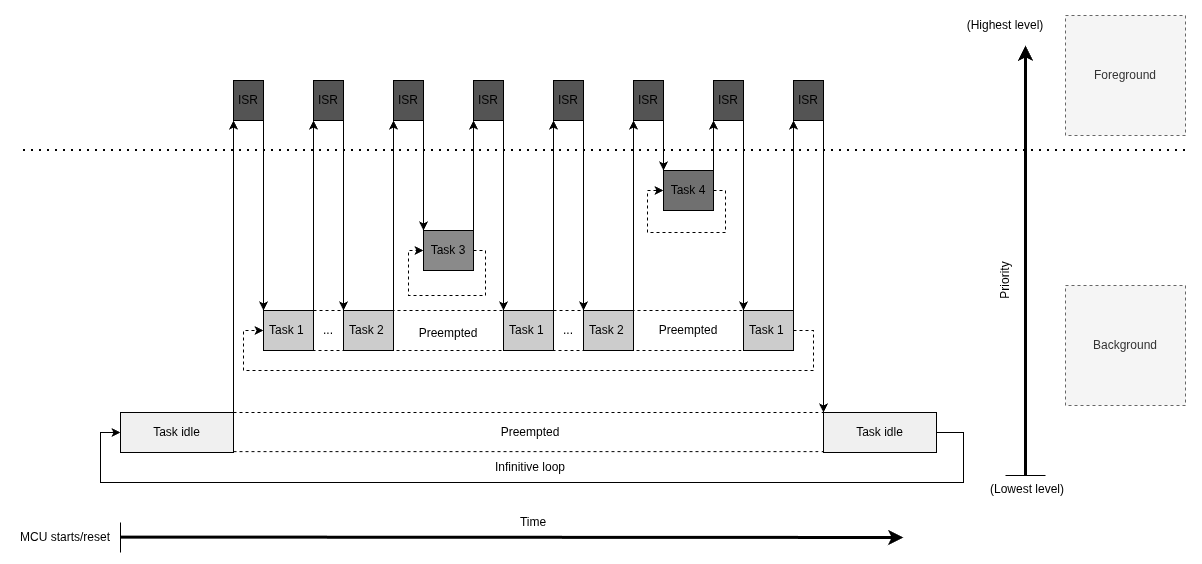
With this model, AKOS provides:
So the diagram gives overview concept of what a typical RTOS does include our AKOS. Not only how threads organized and scheduled but also additional objects listed below.
The rest of the documentation goes deeper into the kernel model, thread management, scheduling, timers, synchronization, communication, and porting so you can see how those pieces fit together in practice.
AKOS is primarily documented around the ARM Cortex-M family, where the current port layer provides the core scheduler and context-switch integration. The architecture split is kept deliberately small so additional targets can be ported without changing the higher-level kernel model.
The examples and build scripts in this repository are written for the GNU Arm Embedded toolchain. The compiler support is kept intentionally focused so the documented build and example flow stays consistent across the repo.
 1.14.0